
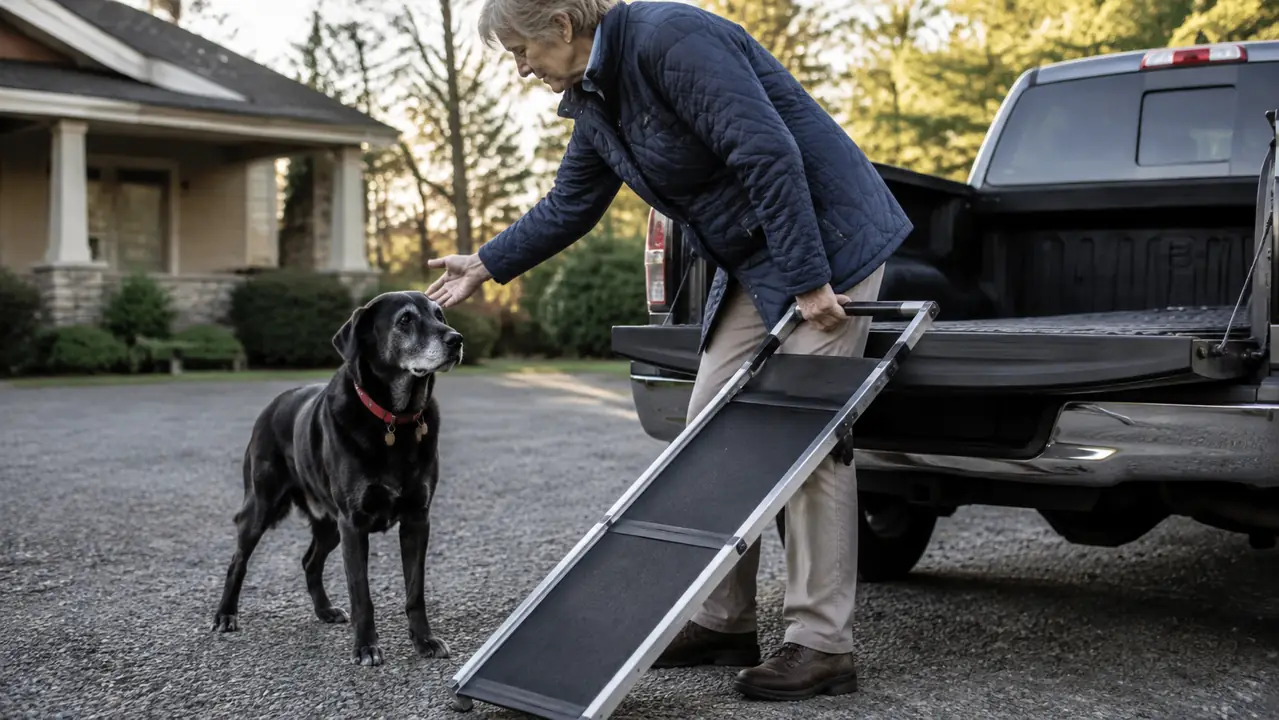
My black Lab mix, Gus, turned thirteen this spring, and his hips told me about it before he said a word. He used to launch off his back feet and clear the passenger seat of my truck in a single hop. This spring he stood at the open door for a full minute, front paws on the seat, hind legs quivering, before he bowed his head and came back to put his chin on my knee like he was apologizing for something that was not his fault.
That left the classic choice in front of me: a set of pet stairs by the bed and the truck, or a folding dog ramp. Both promise to get a stiff old dog from the floor to the bed and from the bed to the truck without a jump. After a month running the PetSafe Happy Ride folding ramp against the little wooden stairs I already had indoors, I can tell you they are not the same invention dressed up differently. They solve different problems, and buying the right one depends on the tallest drop in your house.
How I Put This to the Test
I did not run this test in a laboratory, and that is the point. I spent a month using both in the exact spots a real senior dog lives: beside the bed, at the couch, and at the back of my truck. I set the folding ramp at a working angle on the gravel by the tailgate and left it there all week so Gus got used to seeing it. The stairs sat at the bedside morning and night. I kept a running count of which one he reached for on his own, because a tool a dog avoids is a tool you will stop setting up.
The rules I held myself to: no carrying Gus up or down anything for the whole month, no treats on either tool after the first week, and I let him choose his path every single time. A dog with arthritis will not choose the harder thing out of politeness. If he picked the stairs over the ramp or the ramp over the stairs eight mornings out of ten, that was his honest vote.
| Folding Dog Ramp (PetSafe Happy Ride) | Pet Stairs | |
|---|---|---|
| Easiest on sore hips | One steady incline, the dog never lifts a hind leg off the ground | Each step means lifting a stiff arthritic leg up one at a time |
| Getting into the car or truck | Ramps to the tailgate and handles the tall door drop, folds to carry along | Steps wobble at a car edge and the last drop is too high to manage safely |
| Floor space in the bedroom | Needs a long clear run of floor to reach a gentle angle | Sits tight against the bed frame in the width of one step |
| Storage when not in use | Folds flat like a camp chair and slides behind a door or in the truck | One bulky piece that has to live where you use it |
| First-week trust for a cautious dog | Some dogs balk at the incline and need a week of treats at the top | Most dogs know the step motion and use them the first night |
| Approximate price | Runs about today's market price on Amazon | A basic set usually costs a good deal less |
Where a Folding Dog Ramp Wins
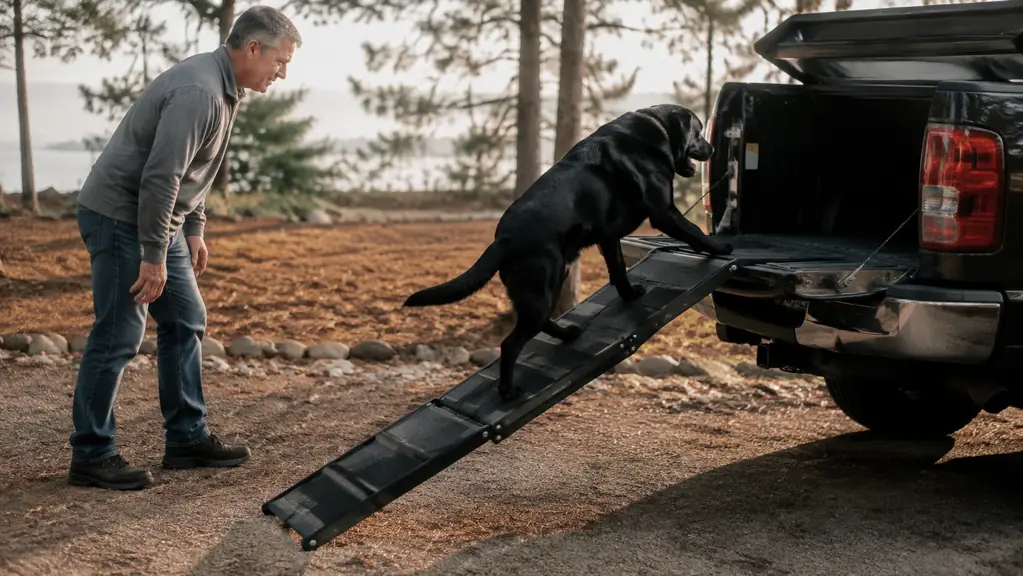
The folding dog ramp wins the moment the target is tall. For Gus, that target is the back of the truck. The drop from the tailgate to the ground is close to two feet, and no set of stairs handles that. Even a tall set of steps wobbles at a door edge and leaves the top step hovering dangerously high for a dog who cannot lift his own hind end. The PetSafe ramp lays out a steady inclined plane from the asphalt to the tailgate, so Gus walks up on all four legs the whole way instead of boosting a stiff hip up one step at a time. That one continuous motion is the entire reason the ramp exists, and it is where it beats every stair on the shelf.
It also wins the storage argument, which I underestimated at first. A set of stairs that is not at the bedside becomes clutter in a hallway. The Happy Ride folds flat to roughly the size of a folded camp chair and slides behind the mudroom door or rides under the backseat of the truck. In a house that already holds a dog bed, two orthopedic beds, and a ramp on the back porch, floor space is a budget of its own, and the ramp spends almost none of it.
One more thing the ramp does that stairs cannot: it doubles as a loading bridge for a dog who has lost confidence in his back legs. On the worst days, when arthritis flares up after a cold night, Gus walks slowly up the incline but he walks up it under his own power. He is not lifted and he is not hoisted, and he keeps using the muscle tone he has left. For an older dog, the difference between moving himself and being carried is the difference between holding his strength and losing it.
Where Pet Stairs Win
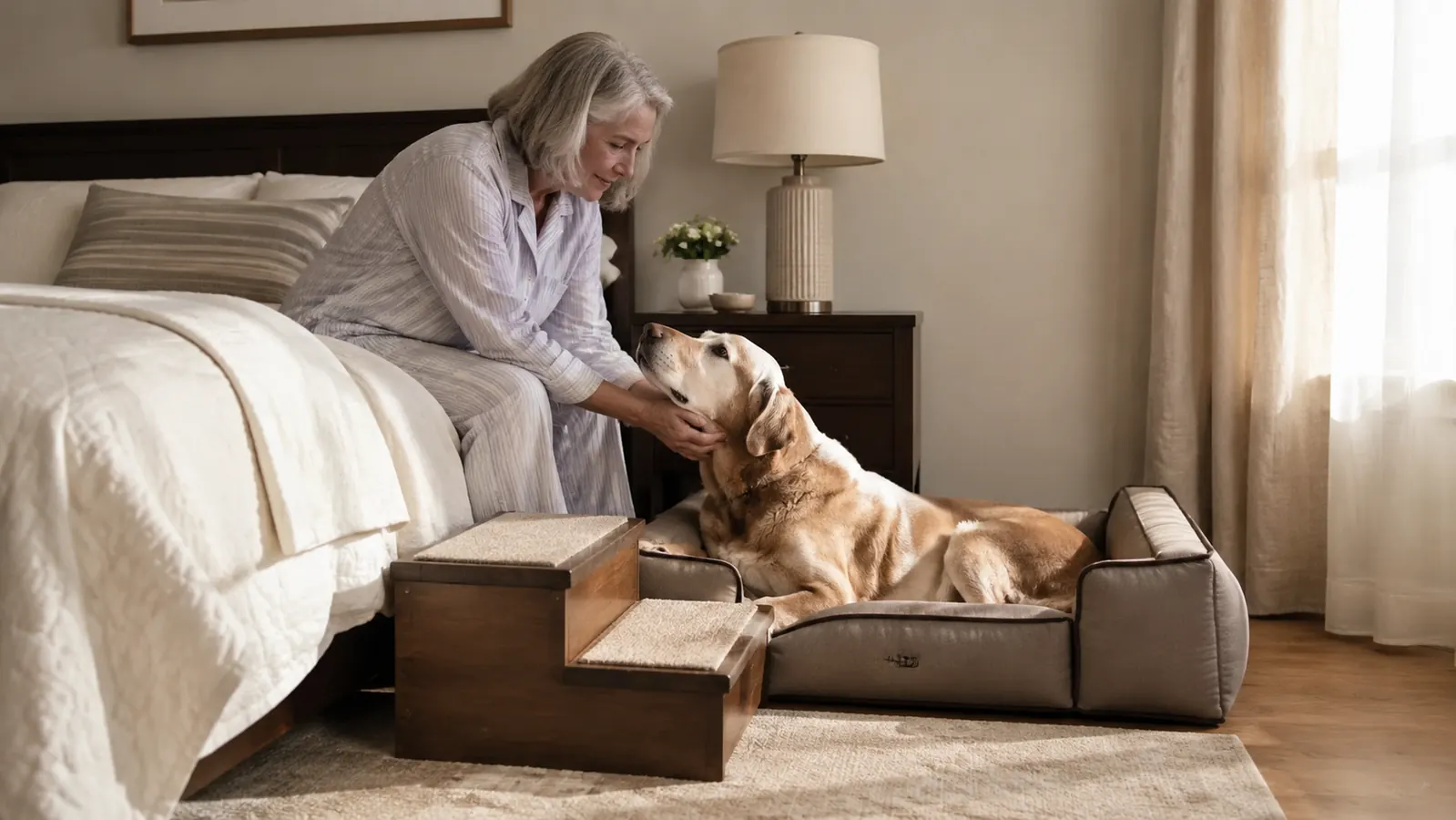
Pet stairs win on the flat bedroom floor, and for a senior dog that is half the battle. The rise from the floor to Gus's orthopedic bed is only about a foot and a half. To reach a gentle angle the ramp needs several feet of clear run, and my bedroom simply does not have it. A two-step stair set right against the bed frame fits in the width of one step and stays put because it never has to move. If the only job in your house is getting a stiff dog onto a low bed, stairs do it with less floor, less fuss, and a good deal less money.
The other thing nobody tells you is that most dogs take to stairs faster. Gus knows the step motion cold from years on our back porch, and he walked the two bedroom steps the first night with no reward at all. On the ramp he stalled for a solid week, sniffing the edge and circling around it, until I parked a dab of peanut butter at the top to earn his feet. If your dog is cautious, the familiar step wins the first-week trust battle almost every time.
And because the stairs never leave the bedside, they become part of the night routine instead of an event. Gus pads from the floor to his bed on his own in the small hours rather than waking me to help him up. On a tool that stays up, there is nothing to remember and no setup to skip.
My Lab mix stalled at the folding ramp for a week, then walked the two bedroom stairs on his first night. That difference is the whole story in one picture.
The Sign Your Dog Already Showed You
If you are reading this because your dog is already hesitating, you likely know the two sure signs. The first is the pause at a jump he used to clear without thinking, the front feet going up and then the back legs refusing to follow. The second is the way he finds a route around an obstacle, lapping over to the porch steps or going the long way past the sofa, because the direct path now hurts. Both of those showed up in Gus a full year before I did anything about it, and I wish I had moved faster.
The honest part is that neither a ramp nor a set of stairs is a cure. Nothing I bought fixed his hips. What a good tool bought was a way to keep him comfortable in our own house without dropping our quality of life to match his stiffness. It gets him onto his favorite bed and into the truck for the ride to the park, and the moments he still gets are worth more than the price of either option.
The Safety Detail Nobody Checks First
Whatever you choose, check the traction before you spend. On the ramp, look for a raised rubber or carpet tread surface, because a slick incline is worse than no help at all. The PetSafe Happy Ride surface is stepped, which gives Gus's pads something to grip on both the way up and the way down, and backing down a ramp is where a senior dog is most likely to slip. On stairs, the make-or-break is whether each tread carries non-slip grip. A painted wood stair with bare feet is a fall waiting to happen on a dog with unsteady hips.
Width matters too. A ramp that is too narrow for your dog's stance turns an easy walk into a tightrope, and stairs with slim tread edges invite a paw to slide off the side. Oversize for your actual dog, not for the picture on the box. Gus is broad-chested, so I wanted a ramp wide enough that he could square up without worrying about either edge.
When the tall drop is the problem, pick the folding ramp
If the hardest job in your house is getting a stiff dog into a car, truck, or RV, the PetSafe Happy Ride folding ramp turns a jump into a normal walk. It folds flat for storage and its stepped surface gives old pads real grip on the way down.
Amazon Check Today's Price on the PetSafe Ramp on Amazon →The Budget Question Nobody Advertises
Here is where the honesty needs to come in. For a house where the only tall drop is the car, the ramp is the whole answer and worth its price. For a house where the dog mostly moves between floor, couch, and bed, a set of stairs gives you ninety percent of the benefit for a fraction of the cost, and the extra money is better spent on the joint supplement the vet already recommended. The mistake is buying the grandest option for the smallest job, because a ramp you stash in the closet and never set up is worth less than a modest stair you actually use.
My own solve after the month was both, and it did not hurt the budget much. A compact set of stairs stays at the bedside for the night and morning trips. The folding PetSafe ramp lives in the truck and comes out at the tailgate, where it earns its keep on every run to the vet and the park. If your house truly needs both, buy the stairs cheap and put the ramp money into the tall job.
Who Should Buy Which
Buy the folding dog ramp if most of the hard work in your house is tall: loading a senior dog into an SUV, a truck, or an RV, or lifting onto a high bed where there is no room for stairs. Buy it if you travel, because a ramp that folds stores and carries easily. And buy it if your dog, like so many with arthritis, would rather walk a steady incline than haul a heavy hind end up a perch.
Buy pet stairs if your dog's world is mostly level: floor to a low couch, floor to a bed that sits low, a single porch step. Buy them if floor space is tight, or if your dog is nervous and a familiar step wins them faster. For a deeper read on living with the ramp over months, my long-term review of the PetSafe Happy Ride covers wear and traction over time, and my guide to helping a senior dog into the car walks through the whole lifting-free routine.
One more honest line between the two: expect a learning curve on whichever you pick, and build a week of patience into the plan either way. A dog who has spent thirteen years jumping is not thrilled about walking up a gentle incline the first time, no matter how good the tool is. Keep treats by the top and take the first few climbs when Gus is already settled rather than amped up. Within a week, either option becomes the boring, ordinary path, and that is exactly when it starts working.
My Bottom Line
Both of these tools deserve a place in a senior-dog house, and neither is a gimmick. The honest rule I land on is this: match the tool to the tallest drop you actually face, not the one you are scared of. For my truck and my travels, the PetSafe folding ramp is the answer, and it has put a stop to the morning ritual of Gus standing at the open door with his chin on my knee. For the bedside, a small firm stair does the job better and cheaper, and my back is grateful either way.
My pick for the tall jobs around your house
The PetSafe Happy Ride is the folding ramp I keep in the truck for Gus's tailgate runs. See its current price and what other owners report before you decide.
Amazon See Today's Price on the PetSafe Ramp on Amazon →