
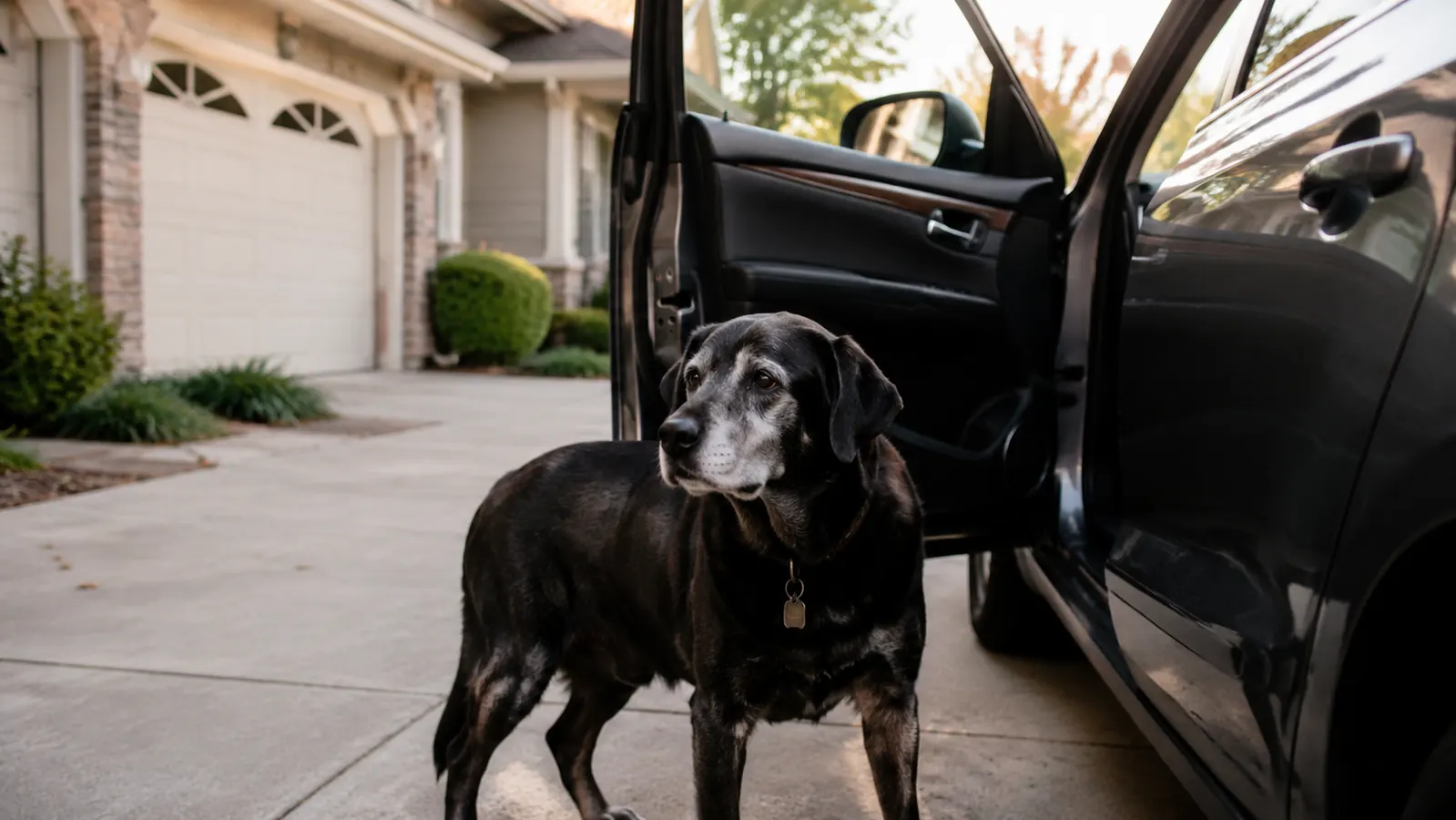
For years I lifted my 78-pound hound mix, Otto, into the back of our SUV the same way every time. I grabbed his chest with one arm, his rear with the other, and heaved. He tolerated it. My back tolerated it. Then one Saturday morning, as I reached down for him before a vet appointment, my lower back gave out. I spent the appointment in a plastic chair, and Otto spent the ride flat-eyed and nervous because he could not understand why I hurt.
That is the part nobody warns you about. A bad lift does not just strain your own back. It makes the dog worry and brace, and a braced arthritic dog is exactly the one most likely to lunge or slip on the way in. For us the fix was the PetSafe Happy Ride folding dog ramp. PetSafe built a ramp that takes real weight in stride, and it finally let Otto walk into the car on his own four feet instead of being heaved in. This is the step by step method I use now, lifting almost nothing and letting him do the walking he still can.
The ramp that ended my heavy lifting, and Otto's fear of the car
A folding dog ramp turns a high heave into a gentle walk, for a dog who still has his legs but cannot jump the height. It set up in seconds in our driveway and it folds flat behind the back seat.
Amazon Check Today's Price on Amazon →Why This Gets Harder Every Year, for Both of You
A younger dog launches into the back of a car without thinking about it. They coil, they pop, they land ready for the window. A senior dog does not coil the same way anymore. Their rear legs push off with less force, their front legs do not want to take the shock of a landing, and the height of a common SUV back end can be close to the length of the dog's own body. Every attempt at that jump is a small test their joints are slowly failing.
The dogs that handle it best are the ones whose owners stepped in early and changed the routine before the dog stopped trying. Once a dog has missed a jump, or landed wrong and yelped, the fear sticks. Otto got to the point where he would pace and back away from the open hatch. That was the cue I should have read long before. The moment a senior dog hesitates at the car, that is not a stubborn dog. That is a dog telling you the jump stopped being worth it.
Step 1: Read Your Dog Before You Even Open the Door
The whole method starts with a two-second look at the dog. Does she trot up to the car with her tail up, or does she slow down, drop her head, and brace? Does she put her front paws on the seat ledge and hesitate, or does she plant all four and refuse to move? That hesitation is not drama. It is the honest report from joints that hurt. A dog who plants her feet is telling you the height is no longer worth it, and forcing past that is exactly how a back injury happens.
I keep a folded ramp and a small collapsible step in the back of the car all the time now, so the choice belongs to Otto instead of to me. Caregivers without any equipment still have good options, and they all start the same way: never lift a dog who is offering to help, and never force a dog who has already said no. If she is calm and walking forward, let her try on her own terms. If she plants her feet, stop and switch to one of the gentler methods below.
Step 2: The Lift, Done So It Does Not Jerk or Twist
When a lift is truly unavoidable, the way you do it matters more than whether you do it. The classic grab under the chest and rear and heave, the move that got me, is the worst of all. It lifts the spine like a hammock, bends your own back forward, and gives a nervous dog nothing to hold her front paws onto. A dog being lifted should feel like she is on a flat platform, not like she is swinging in a rope tied to two poles.
The safer version uses a towel or a long folded blanket as a sling. Slide it under her belly, one side open like a ramp she can reach behind her for balance. Grab the two ends of the sling with one hand at her chest or shoulders and lift with your legs, keeping your own back straight and your knees bent. Your free hand stays on her side so she knows you are there. Lift her rear first, then her front, in one smooth move, and set her front paws onto the seat edge so she can push off with her own muscle instead of hanging helpless. For most dogs that little push of their own makes a big difference in trust.
Two people, one at the chest and one at the rear, lifting together on a count of three, is even safer for a heavy dog. Pick one of you to call the count. Whoever lifts the rear should slide a hand under the far thigh, not between the legs, so the leg hangs naturally. If a dog has bad hips, keep her rear from rotating out to the side while you lift; a twist is what pulls a hip. Go slow, talk in a low calm voice, and reward the calm, not the speed.
Step 3: A Ramp So You Rarely Have to Lift at All
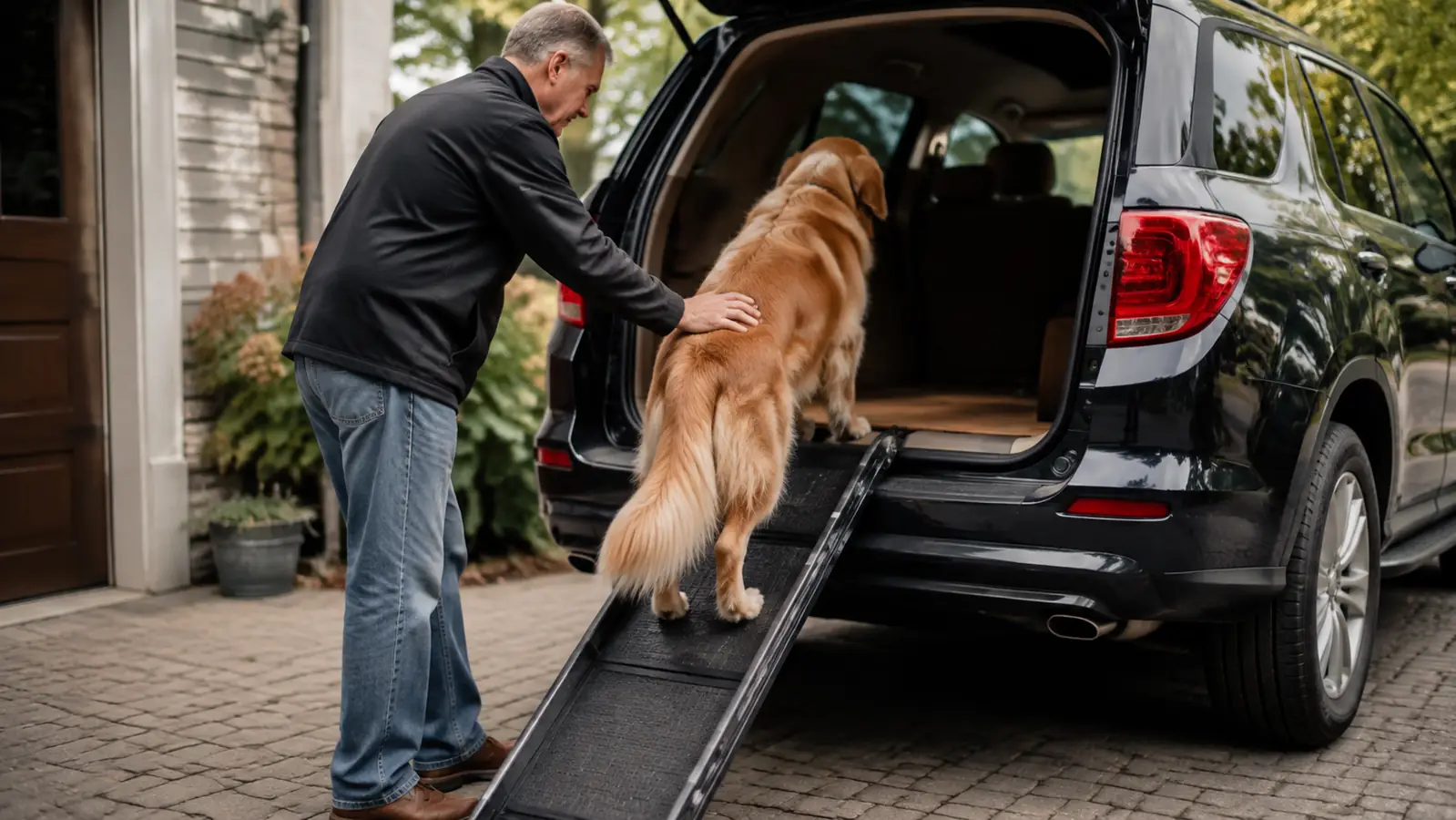
A ramp is the honest answer for most senior dogs because it uses the legs they still have and saves the lift for special days. The PetSafe Happy Ride folding ramp sits with one end on the floor and the other on the floor of the car, giving the dog a gentle walk instead of a jump. Otto still walks himself up it most days, tail level, and he does it without the frozen pause I used to see at the open hatch. Removing the jump removed the fear. I kept notes on the whole first month with the PetSafe ramp, and I put the full accounting, strengths and quirks, in my PetSafe Happy Ride review.
Set it so the slope is as gradual as your car allows. If you can angle it toward the middle of the rear cargo floor instead of straight over the bumper, do that. A gentler slope means a softer walk for stiff hind legs, and it keeps the ramp from springing under a heavy dog. Give the dog a first pass with no pressure, just let her sniff the ramp and stand on it while it rests on the ground. Some dogs take to it the first try and some need a few days of treats on the low end before they will believe it holds them.
The traction surface matters. Our driveway gets damp after rain, and a wet ramp is a slipping hazard for a dog who already has a shaky rear end. I wipe the top of ours with a towel before Otto steps up, and I keep one hand ready at his side, not pulling him, just there for confidence. The first time a dog walks a ramp on his own, that is the win. It means the tool worked and your back stayed rested. A ramp quietly pays off far beyond the car, and I rounded up a dozen of those places in my list of ways a dog ramp helps a senior dog.
Step 4: Make the Landing and the Ride Comfortable
Getting the dog into the car is only half the job. A senior dog needs a place to land that keeps her from sliding and from taking the last jump badly. Lay a non-slip mat or an old bath mat on the cargo floor so her hind feet have traction when she steps off the ramp onto the bare floor. A dog who skids on a smooth trunk liner loses her confidence for the next time even if she made it in safely this time.
Turn her around to face the hatch before you close it. A dog who faces the exit is calmer because she can see out, and she can brace her front paws on the ramp or your hand instead of spinning blind. Keep the ride gentle and the stops smooth. For a stiff old dog, every hard brake is another jolt to the hips. A cushioned pad under her keeps the metal floor from pressing on elbows and hocks during a longer drive.
Step 5: Getting Down Is Where Most Dogs Hurt Themselves
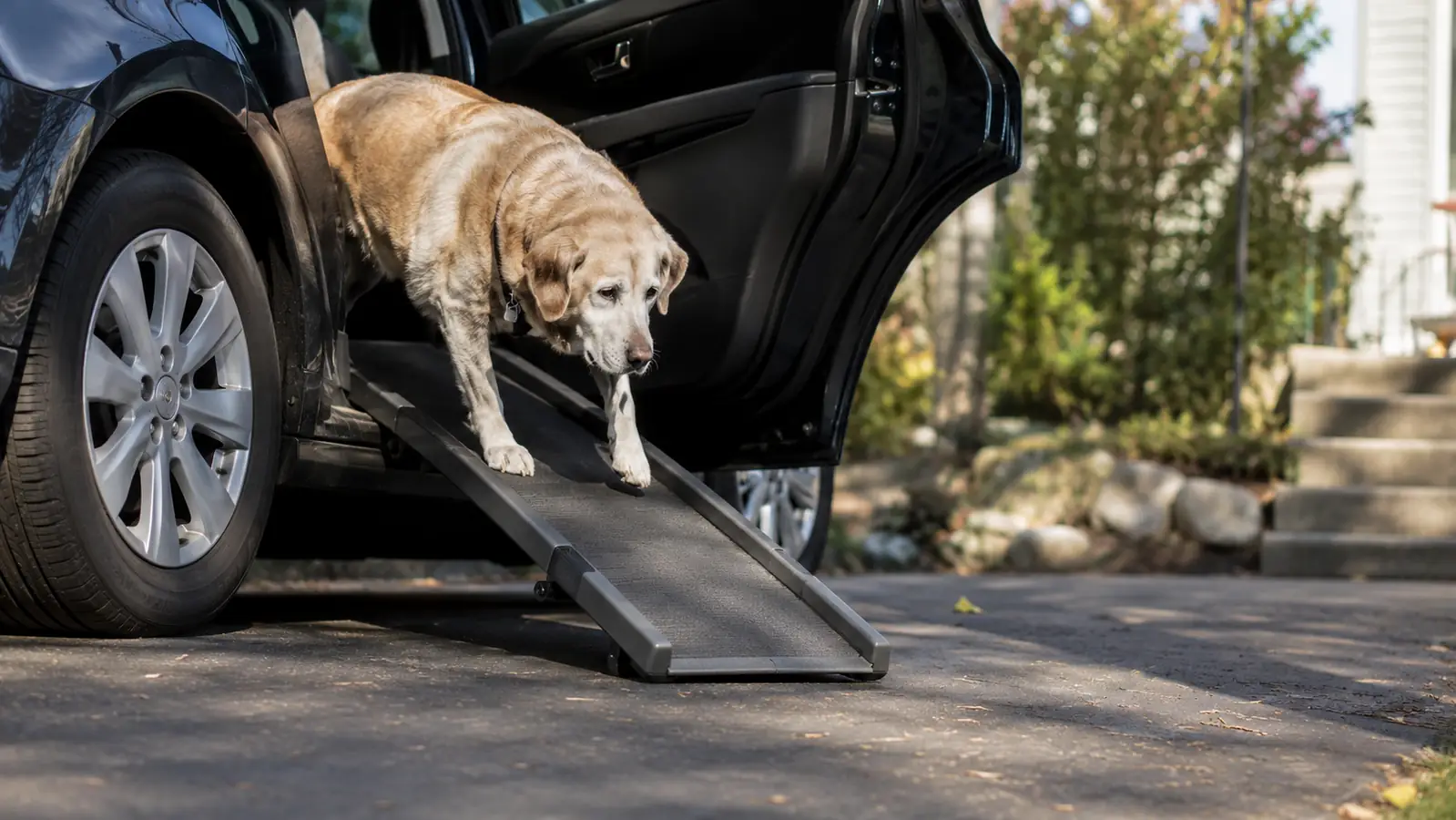
The jump down is the part people forget, and it is frequently the worse of the two for arthritis. Coming down, the front legs take the full shock and the rear legs have to lower the body slowly and under control. A dog who can climb up into the car may still balk at the drop back down to the ground because the landing hurts. That is why a ramp earns its keep twice: it makes the easy part easy and the hard part gentle.
When Otto comes down, I back him out first so his front paws reach the ramp before his rear leaves the car. He can feel the incline under his front feet and follow it down instead of dropping off a ledge. I keep one hand flat under his chest the whole way, just under the sternum, ready to catch but not pulling. Let the dog step down at his own speed. A dog who rushes down out of habit will not slow because you asked, so make the routine the same every time and teach him that the ramp is the way home.
After a long drive, give the dog a couple of minutes on the grass before hauling her straight down. A dog who has been cramped in one position for an hour is at her stiffest right then. Let her trot a few wobbling steps, shake, and find her legs before you ask her to navigate the drop. The few extra minutes save the dog a world of pain and the ramp a harsh high-impact landing.
What Else Helps
A ramp fixes the car, but the stiffness that made the car hard shows up everywhere else too. A supportive orthopedic bed gives an arthritic dog a firm place to rest so they climb out of sleep stiffer. A daily joint supplement gives their joints the lubrication a senior dog no longer makes on their own. And keeping an old dog gently moving, a few short walks a day instead of one long one, keeps their muscles from wasting, so the legs they do have stay strong enough to walk the ramp.
None of it is miracle work, and none of it should come before a vet check. If your dog suddenly refuses the car when she never did before, or cries when you lift her, see the vet before you change anything. Sudden lameness is different from gradual stiffness. But for the slow, familiar creak of an old dog getting in and out of the car, a ramp plus a soft bed plus a steady supplement routine will carry you both a long way toward comfortable.
Lifting a 78-pound dog out of the back of an SUV is the fastest way to hurt your own back and to knock a dog who already hurts into worse pain. Let the ramp do the lifting.
Give your senior dog the driveway back, and save your back while you are at it
A folding ramp takes seconds to set up, folds flat in the trunk, and turns the hardest part of every vet trip into a gentle walk. It paid for itself the first week we owned it.
Amazon Check Today's Price on Amazon →