
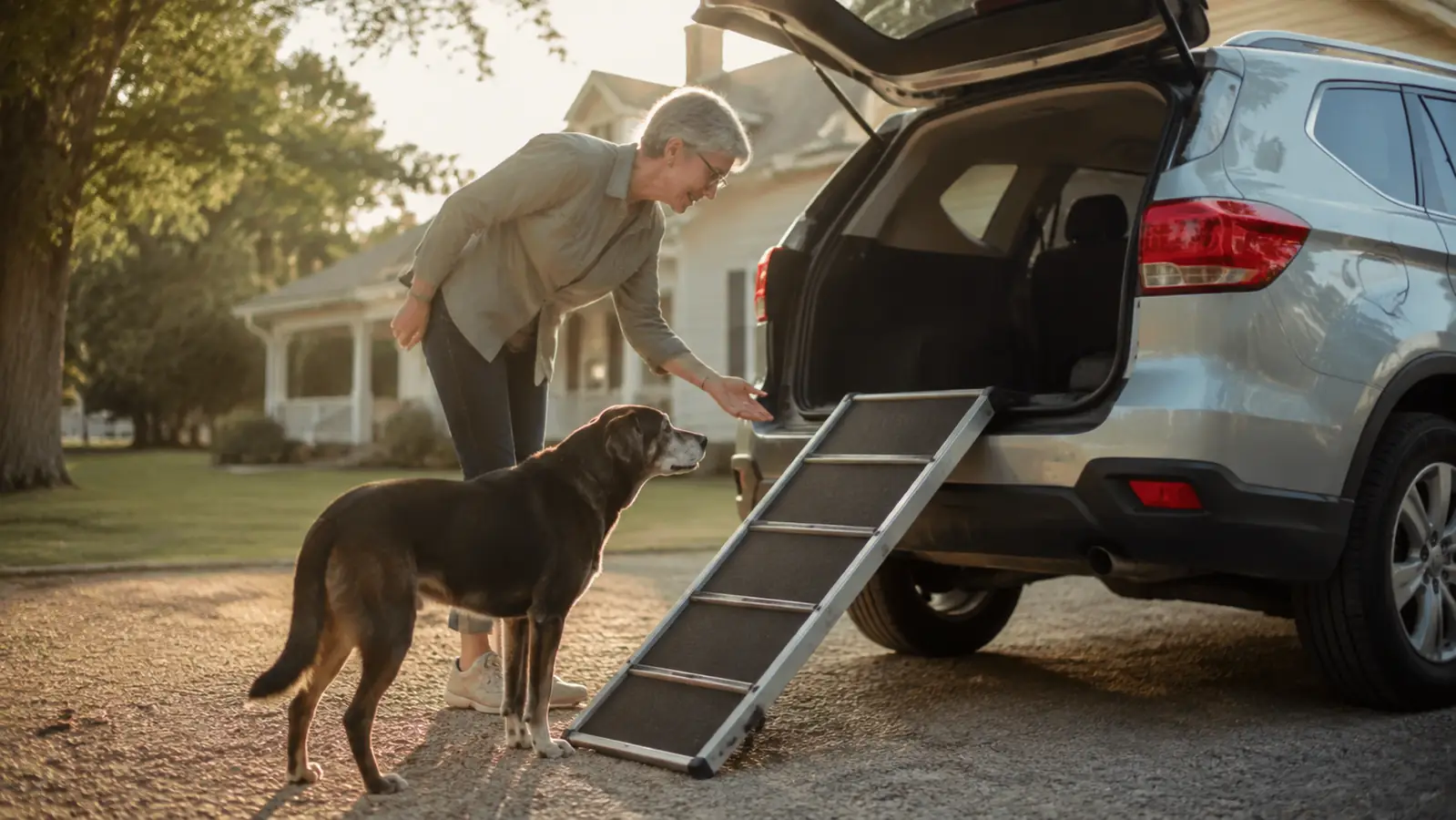
For the last year, getting Duke in and out of my truck has been the one thing I dread about running errands. He is a 13-year-old Labrador mix, 76 pounds on a good day, with hips that creak every cold morning. He cannot jump into the back seat like he used to, so I would grab his back end and lift, and every lift made me think we were both one bad move away from the vet on the same afternoon. My back would lock up by the third carload of feed, and I started planning errands around when my wife was home to help me heft him.
I looked at pet stairs, at a little set of stepping stools, even at a harness with a handle, and none of them solved the real problem, which is one tall step up into a truck and one tall step back down. So I bought the PetSafe Happy Ride folding dog ramp and tested it for two months, twice a day on vet trips, errands, and the Saturday farmers market. This is the honest version of that test, the part the listing photos do not show you. If you are shopping for a ramp for an old heavy dog, you deserve the dull reality, not the marketing.
The Quick Verdict
A sturdy folding ramp that saves your back, if your dog comes to trust it and you watch the traction cover once a month.
Amazon Check Today's Price →Ready to stop lifting your old dog into the car?
If your dog still wants the car ride but cannot make the jump, the PetSafe Happy Ride handles the step while you handle the treats. See today's price below.
Amazon Check Today's Price on Amazon →The Two Ways a Stiff Dog Gets Into a Car, and Why Both Fail
Before you spend a cent, you should know how this usually goes for people our age. Some owners lift the dog and keep lifting until one of them gets hurt. I read enough reviews from my age group to know exactly how that ends, and it is usually the owner who ends up in the walk-in clinic, not the dog. The other way is to buy a ramp, set it up, watch the dog sniff it, circle it, and quietly refuse it, then stash it in the garage and go back to lifting. I want to be honest that both of these endings are more common than the happy photos get across.
The reality of a senior dog is that they do not trust new ground the way a puppy does. A puppy bounds up a ramp like it has been waiting all month for a ramp. A 13-year-old Lab with creaky hips looks at a slope, feels it rock a tenth of an inch under a front paw, and decides the floor is the safer bet. That fear is not stubbornness, it is self-preservation, and it is the single thing every review I read before buying left out. Nobody wants to admit their ramp sat in the garage for two weeks before the dog would touch it.
Both are real outcomes, and I came within a week of being the second story. The fix that works is not the ramp by itself. It is the ramp plus the patience to teach a cautious old dog that the surface is steady. I want to be blunt about that before you buy, because almost nothing in the product photos tells you how much coaxing is involved or how long the first few days take. Budget for treats. Budget for time. If you will not do either, you will be the person with a ramp parked in the corner collecting dust.
I say that not to talk you out of it, but to set the honest expectation that most reviews skip. A ramp is a device that gets used only if the dog decides it gets used. Every hour I spent teaching Duke ended up worth it, but the training time should be a line in your budget, the same way you budget for food and joint treats. That is the real cost of this product, and nobody prints it on the box. The purchase price is the smallest part of what this ramp will ever ask of you.
How I've Used It
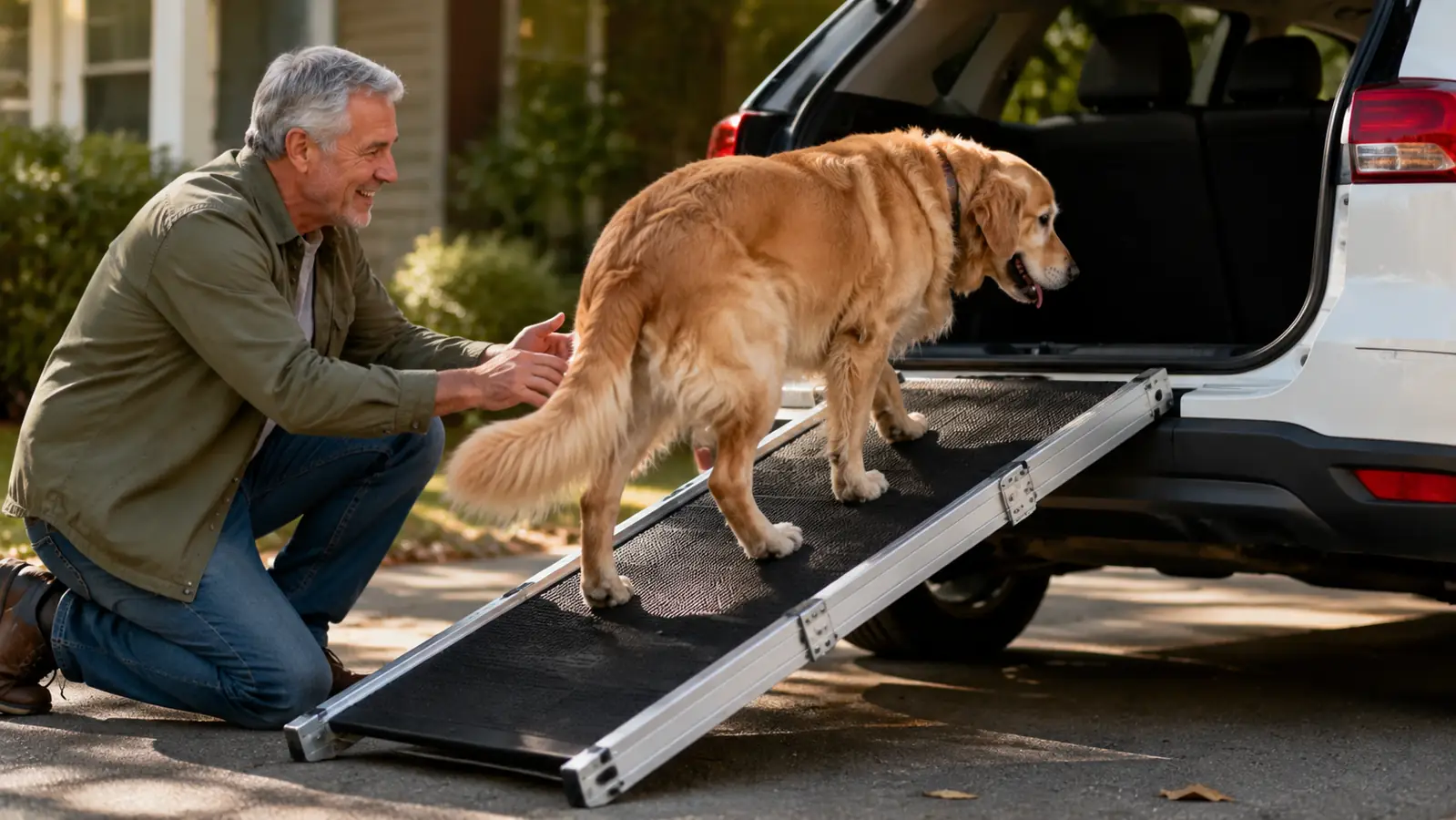
I ran the ramp every day for two months, at least once in the morning and once at night. The first week was almost pure teaching. Duke would step onto the bottom edge, feel it give a little under his weight, and back off. I left treats on the ramp itself for days before I ever tried to walk him up it, and the thing that finally clicked was wedging the ramp more firmly against the truck so it did not shift under his front paws. That tiny bit of extra steadiness was the whole difference between a scary slope and a trustworthy bridge.
Once he trusted it, the rhythm got simple. I set the ramp, let it settle, and Duke walks up behind me and trots straight into the back seat. Coming down is actually harder for him because he is looking at a long downhill slope, so I hold one edge steady and let him take it at his own pace. On the days he is stiff, I do not rush it. The ramp has handled every one of those days, rain and shine, and it has also saved my lower back more times than I can count. I stopped bracing myself at every errand. That alone was worth the space in my garage.
What surprised me most is that the ramp has done double duty around the house. After the car, I tried it on the three porch steps the last two nights, and Duke took to it there almost immediately because the slope is gentler than the truck. I did not buy it for that, but it turns out a folding ramp that lives in the truck can also earn its keep by the back door on a bad morning when the joints are slow. Tucking it flat under the front seat means it goes where the dog goes, and I reach for it more than I expected.
Setup and the Folding Mechanism
The ramp folds in half and locks flat, and it is not heavy. I can carry it in one hand from the garage to the truck, which matters to me because I am not the weightlifter I was at forty. Opening it is straightforward, though fresh out of the box the hinges are stiff. You will want to open and close it a few times on the kitchen floor before you trust it with the dog, because a hinge that sticks can make the dog jump back at the exact moment you need calm. Ten minutes of hinges is a good investment.
It stores flat against a wall or upright behind the back seat, and it does not slide around if you wedge it in place. The raised edges run the full length of the walking surface, and that is the feature I value most. When Duke hesitates and looks back at me, he feels the ridge under his feet and does not step off the side. On a narrow span at truck height, that ridge is the whole difference between confidence and a nervous shuffle. It gave Duke the line to walk before his brain fully agreed to the plan.
One small grumble, and I will count it as the setup complaint rather than the big one: there is no carry handle. You grip it by the folded edge, and that edge has a seam that digs into your palm if you are carrying it from the house to the truck. It is a two-dollar part, and I genuinely wish they had spent the two dollars, because it is the first thing that made me set the ramp down and shake my hand out. Carry it by the middle of the folded seam and it is fine, but you learn that trick the hard way once.
The Weight Limit Nobody Talks About
The listing gives a maximum weight capacity, and that number reads fine on paper. What nobody tells you is that a heavy senior dog does not climb a ramp the way a young dog does. Duke stops halfway up to catch his breath, which means his full 76 pounds settles at a lazy standing rest on a narrow span that sits at an angle. The ramp holds the weight without complaint, the real question is whether the dog is steady when he stops. That pause is more stressful for the owner than it is for the ramp, but you should know it happens.
That pause is the single most important thing for anyone with a big dog to understand. A ramp can be rated for far more than your dog weighs and still feel worrying if the dog likes to stop mid-climb, because the dog is balancing on a slope rather than flat ground. If your dog is the type to pause and look around, think about whether a longer, flatter ramp would suit him better than a short steep one. My Duke stops, and we made it work, but I want you to know the pause happens and it is worth planning for. Hold the ramp steady at the moment he stops and the worry passes.
The good news is that the breathing pause is exactly the situation a ramp exists to handle. On flat ground Duke stands fine, he just lost the spring in his hind legs. The ramp takes away the spring requirement and leaves walking, and walking he can do. So the weight limit that matters is not the manufacturer's printed number, it is whether your dog is steady and calm on an inclined surface. That is the honest test, and it is different for every dog. The ramp's stiff construction played a big part in Duke being willing to stand on it.
The Traction Cover That Falls Off
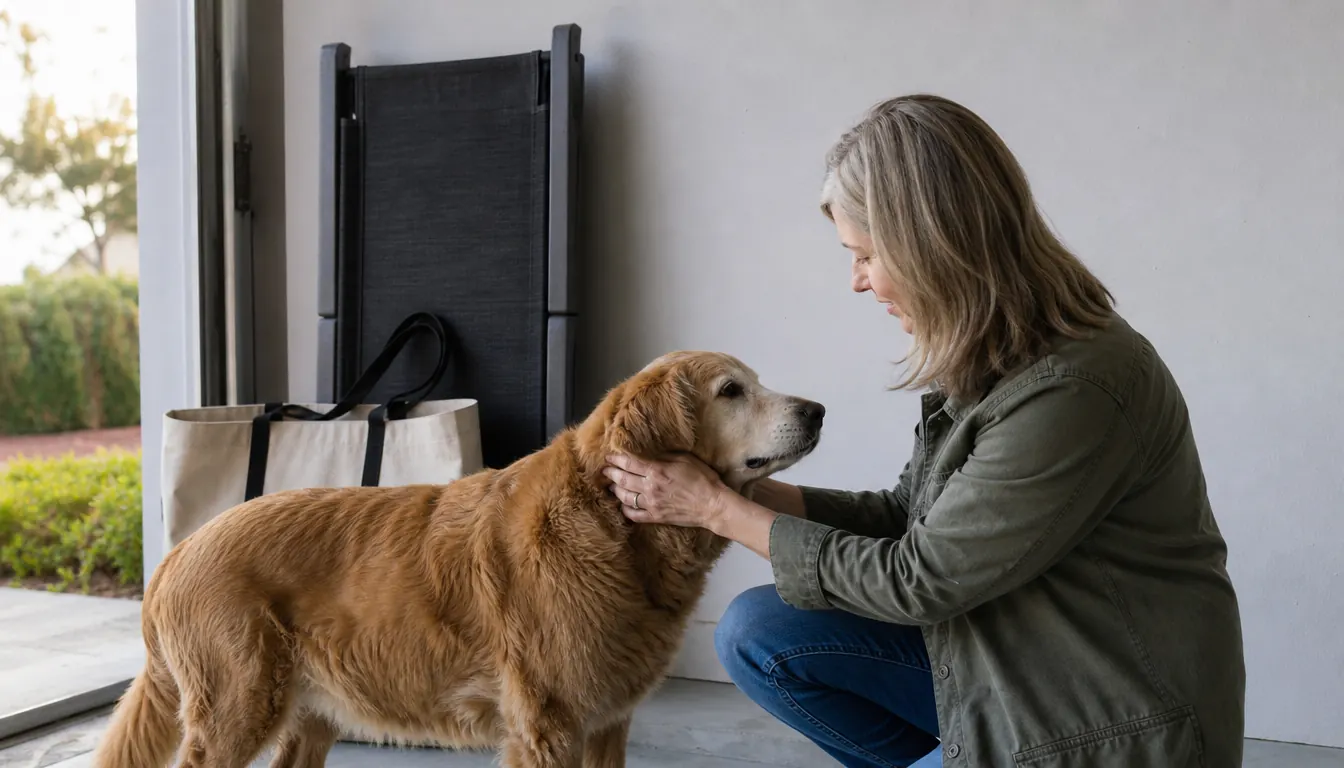
Here is the thing that bothered me most, and the thing the reviews rarely name clearly. The textured traction cover that lines the walking surface is attached at the two long edges, and after a few months of daily use it works loose at one corner. A loose cover means a place where a dog's nail can catch, and a dog who catches a nail once will refuse the ramp for the next three days. That is exactly the frustrating pattern I want to warn you about, before it surprises you on a cold morning when you are already late.
It is a ten-second fix. I check mine about once a month now, press the loose corner back down around the edge, and it holds again for another stretch. The walkable surface itself keeps its grip even when the corner lifts, and on dry concrete or fresh rubber I never felt a slip under Duke's paws. The cover loosening is not a safety failure so much as a maintenance job the product photos quietly leave out. Add it to your routine, the same way you check the tread on your own boots before winter.
The honest verdict on the cover: it is the one part of the ramp I would change, because a monthly check is the sort of thing you forget until the dog catches a nail and you remember the hard way. Keep it in the same cabinet as the treats and you will be fine. This single flaw is why I did not hand this ramp a perfect score, and why my score sits where it does instead. If PetSafe corrected this one detail, the ramp would be close to faultless for the age group it serves.
How It Held Up After Two Months
Beyond the cover, I checked the ramp over once at the end of the second month with a flashlight and a firm hand. The folding latches still click shut with the same snap they had on day one. The frame has no rattle when Duke climbs, no sag where the two halves meet. The rubber feet that hold the bottom edge against the ground are still grippy and have not slimmed down from sliding on concrete. For daily use, the bones of this ramp are wearing well. I was honestly surprised how little it loosened after two months of hard, twice-a-day service.
Rain is the one condition I would caution you about. Duke avoids the ramp in heavy rain now, not because the surface is slick, but because the wet makes him unsure of his footing and he is a cautious dog to begin with. On a dry day he is fine. If you live somewhere with months of wet weather and a dog that spooks easily, you may lean on the ramp less in the winter, and that is worth knowing before you commit. It did not bend or warp in the wet, it is purely a confidence thing on Duke's part.
What I Liked
- Folds flat and stores upright or behind the seat with no footprint
- Light enough to carry one-handed from the garage
- Wide walking deck with raised edges that stop a hesitant dog stepping off
- Sturdy under a 76-pound dog stopping to catch his breath mid-climb
- Earns extra duty on porch steps, not just the car
- Folding latches and feet held up well through two months of daily use
Where It Falls Short
- Traction cover works loose at a corner after a few months and catches nails
- Fresh hinges are stiff and need a dozen open-and-close breaks before use
- No carry handle, and the folded edge seam digs into your palm
- Heavy, pause-prone dogs need weeks of treats to trust the ramp
- Cautious dogs may avoid it in heavy rain
Duke stopped halfway up to catch his breath, and that is the single worst moment with any ramp: a heavy dog settled at a lazy angle on a span half off the truck.
Who This Is For
This ramp is for the owner with a medium to large dog who still wants the car ride but needs help with one tall step. It is for the person who is tired of lifting an old dog and willing to spend a couple of weeks and a bag of treats teaching the dog that the ramp is not going to move. If your dog will walk a plank at ground level without fuss, the PetSafe Happy Ride is a solid, lightweight choice that will spare your back for another year of vet trips and errands. You will not regret giving your spine a rest.
It is especially good if you are the sort of owner who already keeps a tote of pet supplies by the door and does not want one more bulky thing in the way. The flat storage, the light carry weight, and the fact that it doubles as a porch step helper all suit someone who budgets space and money carefully and wants one tool that works in several places. It is a buy-once tool for the right household, and for that household it earns its spot beside the leash every single day.
Who Should Skip It
This is not for someone with a dog under twenty pounds, where a set of pet stairs is cheaper, easier, and plenty. And it may not be for a dog that panics with any drop at all beneath their feet; if your dog wants nothing to do with a few inches of open air at ground level, a ramp at truck height will not fix that fear, it will just add a bigger drop to the thing that already scares them. Rescue a skittish dog like that and you may need a ramp that fits more day-to-day inside the house before you ever point it at a car.
If lifting still works and your back is fine, you do not need a ramp yet. Buy one the day the lift stops being easy. I would also skip it, honestly, if you know you will not keep up the monthly cover check or the initial training week. A ramp that sits in the garage unused is not worth today's price, no matter how well it folds. Buy this when you are sure you will use it week one and check it month one, because that is the difference between a tool and a decoration that just takes up floor space.
Stop lifting. Start driving.
You do not have to choose between a hurt back and a dog who misses the car ride. The foldable PetSafe Happy Ride gets him in and out without either of you straining. See today's price below.
Amazon Check Today's Price on Amazon →